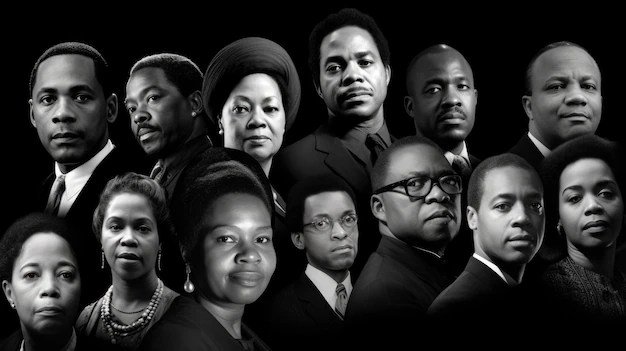
The month of February, Black History Month, serves as a powerful reminder of the extraordinary lives and indelible contributions of African Americans who have shaped the very fabric of society. While this particular guide seeks to illuminate Prominent Black Leaders and Figures from WA Whose Legacies Endure, it's crucial to acknowledge that the foundational history of Black excellence, activism, and innovation is a national tapestry. The lives and struggles of figures across the United United States profoundly influenced, and continue to influence, communities in every state, including Washington. They set precedents, inspired movements, and forged paths that resonate deeply within local contexts, making their national stories an essential part of understanding any state's heritage. This article will delve into the lives of these pivotal figures, drawing from comprehensive historical context to showcase the breadth of their impact and how their enduring legacies inspire and empower us all.
At a Glance: Understanding the Impact of Black Leaders
- Pioneers of Civil Rights: From abolitionists fighting slavery to activists dismantling segregation, these leaders paved the way for equality.
- Architects of Social Change: They founded institutions, organized movements, and advocated for fundamental human rights.
- Innovators in Every Field: Their brilliance transformed science, medicine, technology, education, and entrepreneurship.
- Cultural Icons: Through art, music, literature, and sports, they captured the Black experience, challenged norms, and inspired generations.
- Political Trailblazers: Breaking barriers in government and public service, they redefined possibilities for representation and leadership.
The Unyielding Spirit: Architects of Civil Rights and Equality
The fight for racial justice and equality has been a long and arduous journey, spearheaded by individuals whose courage and conviction shaped the course of American history. These leaders, often risking their lives, laid the groundwork for the freedoms and opportunities we recognize today.
Frederick Douglass (1818-1895) stands as a towering figure in the abolitionist movement. Born into slavery, his escape and subsequent rise as an orator, writer, and statesman were nothing short of miraculous. His autobiography, “Narrative of the Life of Frederick Douglass,” offered a searing, firsthand account of slavery's brutalities, galvanizing public opinion against the institution. Douglass’s sharp intellect and impassioned calls for justice continued throughout his life, making him an enduring voice for human rights.
Similarly, Harriet Tubman (1822–1913), often called the "Moses of her people," embodied immense bravery. Herself an escaped enslaved person, she risked her life repeatedly to guide hundreds to freedom via the Underground Railroad. Her unwavering commitment to liberation extended beyond slavery; she was also a dedicated participant in the women’s suffrage movement, advocating for universal rights.
The legacy of activism continued with figures like Sojourner Truth (1797–1883). Born Isabella Baumfree, her powerful speech, "Ain't I a Woman?," delivered at a women's rights convention, challenged both racial and gender inequality with profound simplicity and force. Her advocacy for abolition and women’s rights demonstrated an intersectional understanding of justice decades ahead of its time.
As the nation moved beyond slavery, the fight for civil rights evolved. Mary Church Terrell (1863-1954) emerged as a prominent suffragette and civil rights activist. She tirelessly campaigned to integrate public spaces, was instrumental in founding the NAACP’s executive committee, and became the first Black woman appointed to a U.S. school board, demonstrating her commitment to both education and equality.
In the mid-20th century, the Civil Rights Movement gained undeniable momentum under the leadership of Martin Luther King Jr. (1929–1968). His philosophy of nonviolent resistance, inspired by Mahatma Gandhi, became the guiding principle for landmark actions like the Montgomery Bus Boycott and the March on Washington. King’s dream of a nation where people are judged by the content of their character, not the color of their skin, continues to inspire movements for justice worldwide.
A quiet act of defiance ignited the Montgomery Bus Boycott: Rosa Parks (1913–2005). Her refusal to give up her bus seat in 1955 became a powerful symbol against racial segregation, earning her the title "the first lady of civil rights." Her singular act sparked a year-long boycott that ultimately led to the desegregation of public transportation.
The struggle for voting rights saw immense contributions from Fannie Lou Hamer (1917–1977), a sharecropper turned fearless voting rights activist. Her powerful, unvarnished testimony at the 1964 Democratic National Convention, describing the brutal repression faced by Black voters in Mississippi, was instrumental in advancing the Voting Rights Act of 1965. Her rallying cry, "I'm sick and tired of being sick and tired," resonated deeply with a nation grappling with injustice.
Other pivotal figures worked tirelessly behind the scenes and on the front lines. Medgar Evers (1925–1963), a WWII veteran and NAACP field secretary in Mississippi, bravely investigated racial violence and fought for equal rights until his assassination in 1963, a tragedy that galvanized support for the Civil Rights Movement. John Lewis (1940–2020), a young firebrand and key figure in the Selma to Montgomery marches, went on to serve as a U.S. Representative for over three decades, carrying the torch for human rights and equality. And Ella Baker (1903–1986), a "behind-the-scenes" leader, was a foundational force, mentoring young activists and helping found the Student Nonviolent Coordinating Committee (SNCC), advocating for grassroots leadership and empowering communities from within. Bayard Rustin (1912–1987), an openly gay Black man, was a key strategist for the Civil Rights Movement, advising Martin Luther King Jr. and helping to plan the historic 1963 March on Washington. His contributions, often overlooked due to his identity, highlight the complexity and diversity of the struggle for freedom.
Breaking Barriers: Trailblazers in Politics and Public Service
The journey toward full participation in American democracy has seen courageous individuals shatter ceilings and redefine what is possible in public service. These political leaders not only achieved personal milestones but also opened doors for countless others.
Shirley Chisholm (1924–2005) stands as a monumental figure. She was the first Black woman elected to the U.S. Congress, serving seven terms, and made history again as the first major-party Black candidate and woman to run for the Democratic Party’s presidential nomination in 1972. Her campaign, "Unbought and Unbossed," inspired generations to challenge the status quo.
More recently, Barack Obama (b. 1961) achieved a historic milestone, becoming the 44th president of the United States and the first Black American to hold the office. His two terms, from 2009 to 2017, saw significant policy changes like the Affordable Care Act and the legalization of same-sex marriage, leaving an indelible mark on the nation and the world.
Following in his footsteps, Kamala Harris (b. 1964) made history as the first woman, first Black American, and first person of South Asian descent to serve as Vice President of the United States. Her career as a prosecutor, Attorney General of California, and U.S. Senator paved the way for her groundbreaking achievement.
In the realm of foreign policy and military leadership, Colin Powell (1937–2021) was a distinguished American statesman and four-star general. He broke barriers as the first Black American to serve as U.S. Secretary of State, with a remarkable career that included roles as National Security Advisor and Chairman of the Joint Chiefs of Staff. Similarly, Condoleezza Rice (b. 1954) became the first Black woman to hold the position of U.S. Secretary of State, serving under President George W. Bush and earning recognition as a respected foreign policy expert.
The judiciary also saw its glass ceiling shattered by Thurgood Marshall (1908–1993). A groundbreaking lawyer and civil rights activist, Marshall became the first Black appointee to the U.S. Supreme Court. His legal prowess, particularly his work with the NAACP, including arguing the landmark Brown v. Board of Education case, fundamentally reshaped American civil rights law.
Beyond elected office, figures like Stacey Abrams (b. 1973) have had a profound impact through activism and advocacy. As a politician, author, and voting rights advocate, her organization, Fair Fight, has expanded ballot access in Georgia by registering hundreds of thousands of new voters, demonstrating the power of grassroots organizing in strengthening democracy.
Illuminating Minds: The Pillars of Education and Intellect
Education has long been understood as a pathway to liberation and empowerment within the Black community. Visionary leaders dedicated their lives to establishing institutions of learning, chronicling history, and shaping intellectual discourse.
Mary McLeod Bethune (1875-1955) was a leading educator and civil rights activist whose impact reverberated nationwide. She founded Bethune-Cookman University in Florida, providing vital educational opportunities for Black youth, and established the National Council of Negro Women, uniting Black women's organizations. Her administrative role during President Franklin Delano Roosevelt’s administration further solidified her influence on national policy.
Carter G. Woodson (1857-1950) is rightfully considered the "father of African American history." Armed with a Ph.D. in history from Harvard, he recognized the profound absence of Black history in mainstream education. He originated the idea of Negro History Week (which evolved into Black History Month) and founded the Association for the Study of African American History, ensuring that Black achievements and experiences would be documented and celebrated.
The intellectual landscape was also profoundly shaped by W.E.B. Du Bois (1868–1963). A prominent sociologist, historian, and civil rights activist, his seminal work “The Souls of Black Folk” and his role as a co-founder of the NAACP positioned him as a key intellectual leader against segregation and racial discrimination. Du Bois’s call for the "talented tenth"—the idea that the Black community needed educated leaders to uplift the race—influenced generations of thinkers.
Earlier, Booker T. Washington (1856–1915), an educator, author, and orator, played a significant role in developing the Tuskegee Institute in Alabama. His advocacy for vocational training and economic self-sufficiency, while sometimes controversial, provided crucial pathways for many Black Americans in the post-Reconstruction era. These educational leaders, though sometimes differing in their approaches, shared a common goal: the upliftment and advancement of Black people through knowledge and opportunity.
Beyond the Horizon: Innovators in Science and Technology
Black leaders have made invaluable, often uncredited, contributions to science, technology, engineering, and mathematics, pushing the boundaries of human knowledge and improving lives globally.
George Washington Carver (1864–1943), a brilliant scientist and inventor, revolutionized farming practices in the southern U.S. He developed over 100 products from peanuts alone, offering innovative agricultural research that assisted struggling Black farmers and diversified the Southern economy.
In the realm of space exploration, Katherine Johnson (1918–2020) was a pioneering mathematician at NASA whose calculations were crucial for the success of early space missions, including the first American-manned spaceflight and the Apollo 11 moon landing. Her remarkable intellect helped America win the space race, all while breaking racial and gender barriers in a male-dominated field. Following in her footsteps, Mae Jemison (b. 1956) became the first Black woman to travel into space in 1992 aboard the Space Shuttle Endeavour, as an engineer and physician. She continues to advocate for science education, especially for minorities and girls. Guion S. Bluford (b. 1942) was the first Black American man to travel into space in 1983 aboard the Space Shuttle Challenger, logging over 680 hours in space as a former U.S. Air Force pilot and aerospace engineer.
Medical science has also seen transformative contributions. Dr. Charles Drew (1904–1950), a pioneering physician and medical researcher, developed large-scale blood banks and improved blood storage techniques. His innovations revolutionized emergency medicine, particularly during WWII, saving countless lives. Later, Dr. Patricia Bath (1942–2019), an ophthalmologist, inventor, and humanitarian, became the first Black woman to receive a medical patent for her Laserphaco Probe, which dramatically improved cataract treatment.
Looking further back, Benjamin Banneker (1731–1806) was a self-taught polymath, almanac author, surveyor, naturalist, and farmer. He made significant contributions in astronomy and famously surveyed the boundaries of Washington D.C., demonstrating extraordinary intellectual capacity. Modern GPS technology owes a debt to Gladys West (b. 1930), a mathematician whose work in satellite geodesy established the foundation for precise mathematical modeling of the Earth’s shape.
Finally, in the realm of modern science communication, Neil deGrasse Tyson (b. 1958), an astrophysicist, author, and science communicator, has made complex scientific concepts accessible to the public as director of the Hayden Planetarium and host of Cosmos: A Spacetime Odyssey. These individuals represent just a fraction of the Black brilliance that has powered human progress.
The Pulse of Culture: Art, Music, Literature, and Sport
Culture—expressed through art, music, literature, and sport—has always been a powerful vehicle for storytelling, resistance, and celebration within the Black community. These cultural icons not only entertained but also provoked thought, challenged norms, and inspired movements.
Duke Ellington (1899-1974), a jazz giant and D.C. native, started playing piano at age 7 and by 20 had formed a band that would become Cotton Club’s house band. He became one of the most influential musicians of the 20th century, forever changing the sound of American music. The "Godfather of Go-Go," Chuck Brown (1936-2012), pioneered D.C.'s distinct Go-Go sound—a vibrant blend of Latin beats, African call-and-response, jazz, and R&B—bringing it national exposure with his 1978 hit "Bustin' Loose." And in the realm of soul, Marvin Gaye (1939-1984), born in Freedman’s Hospital, became part of the iconic Motown sound, earning the nickname "Prince of Soul" and leaving behind a legacy of timeless music. Later, the "Queen of Soul" Aretha Franklin (1942–2018) earned 18 Grammy Awards, was the first woman inducted into the Rock and Roll Hall of Fame, and her powerful music influenced both the Civil Rights and Women’s Rights Movements. The innovative and influential American jazz musician, Miles Davis (1926–1991), was renowned for developing several key jazz styles, including bebop, cool jazz, and jazz fusion. Nina Simone (1933–2003), the “High Priestess of Soul,” used her classically trained piano skills and powerful voice to create music like “Mississippi Goddam” that became anthems for the Civil Rights Movement. And of course, the iconic jazz musician Louis Armstrong (1901–1971), known for his charismatic stage presence and innovative contributions to the genre, including his distinctive voice and trumpet playing, redefined jazz globally. Marian Anderson (1897–1993), a celebrated contralto, broke barriers in classical music, with her historic 1939 concert at the Lincoln Memorial becoming a significant moment in the struggle for Black artists.
In literature, Paul Laurence Dunbar (1872-1906) was a famed African American poet whose works, often using dialect, influenced Harlem Renaissance writers. Langston Hughes (1902-1967) was a central Harlem Renaissance poet, novelist, playwright, and columnist, whose book of poetry, "Weary Blues" (1926), captured the spirit of Black life. Zora Neale Hurston (1891–1960), a prolific writer and anthropologist, was central to the Harlem Renaissance and known for her powerful portrayals of racial struggles in the early-20th-century American South. Maya Angelou (1928–2014), an influential poet, singer, and memoirist, is celebrated for her seven autobiographies detailing her childhood and early adult experiences, speaking truth to power through her elegant prose. Toni Morrison (1931–2019), an acclaimed American novelist, essayist, and professor, earned a Nobel Prize for her powerful narratives exploring Black identity and experience. And James Baldwin (1924–1987), an influential writer and social critic, explored race, sexuality, and class in mid-20th-century America through his essays, novels, and plays, including “Go Tell It On the Mountain.” These literary giants gave voice to the Black experience, crafting narratives that resonated universally.
The visual and performing arts also saw groundbreaking talent. Alvin Ailey (1931–1989), an influential choreographer, founded the Alvin Ailey American Dance Theater in 1958, revolutionizing modern dance by incorporating Black culture and social commentary. Jean-Michel Basquiat (1960–1988), a groundbreaking artist from the New York graffiti scene, reshaped contemporary art culture with vibrant paintings exploring themes of identity, race, and social inequality. More recently, Chadwick Boseman (1976–2020), an actor and storyteller, was celebrated for portraying real-life legends like Jackie Robinson and James Brown, as well as the groundbreaking superhero Black Panther, leaving an indelible mark on cinema.
Entrepreneurship also created vital avenues for empowerment. Madam C.J. Walker (1867–1919), born Sarah Breedlove, was America's first female self-made millionaire, building her fortune by developing and marketing beauty and hair products specifically for Black women, creating economic independence for countless others.
In the world of sports, Jackie Robinson (1919–1972) broke the color barrier in Major League Baseball in 1947 with the Brooklyn Dodgers. His success challenged racial segregation in sports and society, paving the way for Black athletes. Muhammad Ali (1942–2016), a legendary boxer and social activist, was known for his charismatic personality, opposition to the Vietnam War, and commitment to social justice. His impact transcended the ring. Michael Jordan (b. 1963), widely regarded as one of the greatest basketball players of all time, with six NBA championships and five MVP awards, significantly influenced global NBA popularity and athlete marketing. Serena Williams (b. 1981), one of the greatest athletes of all time, has dominated women’s tennis with 23 Grand Slam singles titles and is a vocal advocate for gender equality and women’s rights. LeBron James (b. 1984), a professional basketball player with multiple NBA championships and MVP awards, is also recognized for his philanthropy and activism. And in popular music and entertainment, Beyoncé Knowles-Carter (b. 1981) is a groundbreaking singer, songwriter, and actress, a bestselling music artist celebrated for empowering women and advocating for racial equality. Finally, Ice Cube (b. 1969), a rapper, actor, and filmmaker, rose to fame with N.W.A. in the late 1980s, then pursued a solo music career and starred in/produced films like Friday and Barbershop, showcasing his enduring cultural influence.
These figures, in their diverse fields, demonstrate the profound and expansive impact of Black creativity, resilience, and talent across the global stage.
Beyond February: Embracing Black History Year-Round
While Black History Month provides a dedicated time for reflection and celebration, the work of understanding and honoring the legacies of Prominent Black Leaders and Figures is a year-round commitment. Their stories are not confined to a single month, but rather are integral to the broader narrative of human progress and the ongoing pursuit of justice.
Why is it important to celebrate these leaders?
Celebrating these leaders is vital because their experiences and achievements offer profound lessons in resilience, courage, innovation, and the power of human spirit. They remind us of the progress made and the persistent challenges that demand our attention. Their stories provide role models for overcoming adversity, inspiring future generations to strive for excellence and equity.
How can their legacies inspire us today?
Their legacies inspire us to challenge injustice, advocate for the marginalized, innovate in our fields, and lead with integrity. Whether it's the nonviolent resistance of Martin Luther King Jr., the scientific brilliance of Katherine Johnson, the artistic expression of Maya Angelou, or the entrepreneurial spirit of Madam C.J. Walker, each narrative offers actionable principles for personal and societal betterment. They encourage us to look beyond perceived limitations and contribute meaningfully to our communities.
What's the role of local communities (like in WA) in continuing this work?
Even without specific details in the provided historical context regarding "Prominent Black Leaders and Figures from WA," the national figures discussed here serve as potent inspirations for local action. Communities in Washington, like those across the country, can continue this work by:
- Educating: Integrating Black history into local curricula, hosting community discussions, and supporting educational initiatives.
- Advocating: Engaging in local activism for racial justice, voting rights, and equitable opportunities within their cities and towns.
- Celebrating: Recognizing local Black leaders and trailblazers, ensuring their stories are told and their contributions are honored through local landmarks, awards, and community events.
- Supporting: Patronizing Black-owned businesses, supporting local Black artists, and investing in organizations that uplift Black communities.
- Preserving History: Documenting the unique contributions of Black individuals and communities within Washington state, ensuring their historical narratives are accurately recorded and shared.
For those eager to delve deeper into the rich and vibrant heritage of Black individuals and communities in the state of Washington, there are many local resources and organizations dedicated to preserving and celebrating this history. You can begin to Explore Washingtons Black heritage to discover the specific contributions and stories that have shaped your local landscape.
Carrying the Torch Forward: A Call to Action
The journey for justice and equality is ongoing. The legacies of these prominent Black leaders and figures serve not as endpoints, but as beacons guiding our path forward. Their lives underscore the importance of continuous learning, critical engagement, and unwavering commitment to creating a more just and equitable world for everyone.
Embrace the lessons from their struggles and triumphs. Seek out diverse voices, challenge your own perspectives, and actively participate in building communities where all individuals can thrive. Whether through quiet determination or public advocacy, each of us has a role to play in ensuring that the torch of progress continues to burn brightly.